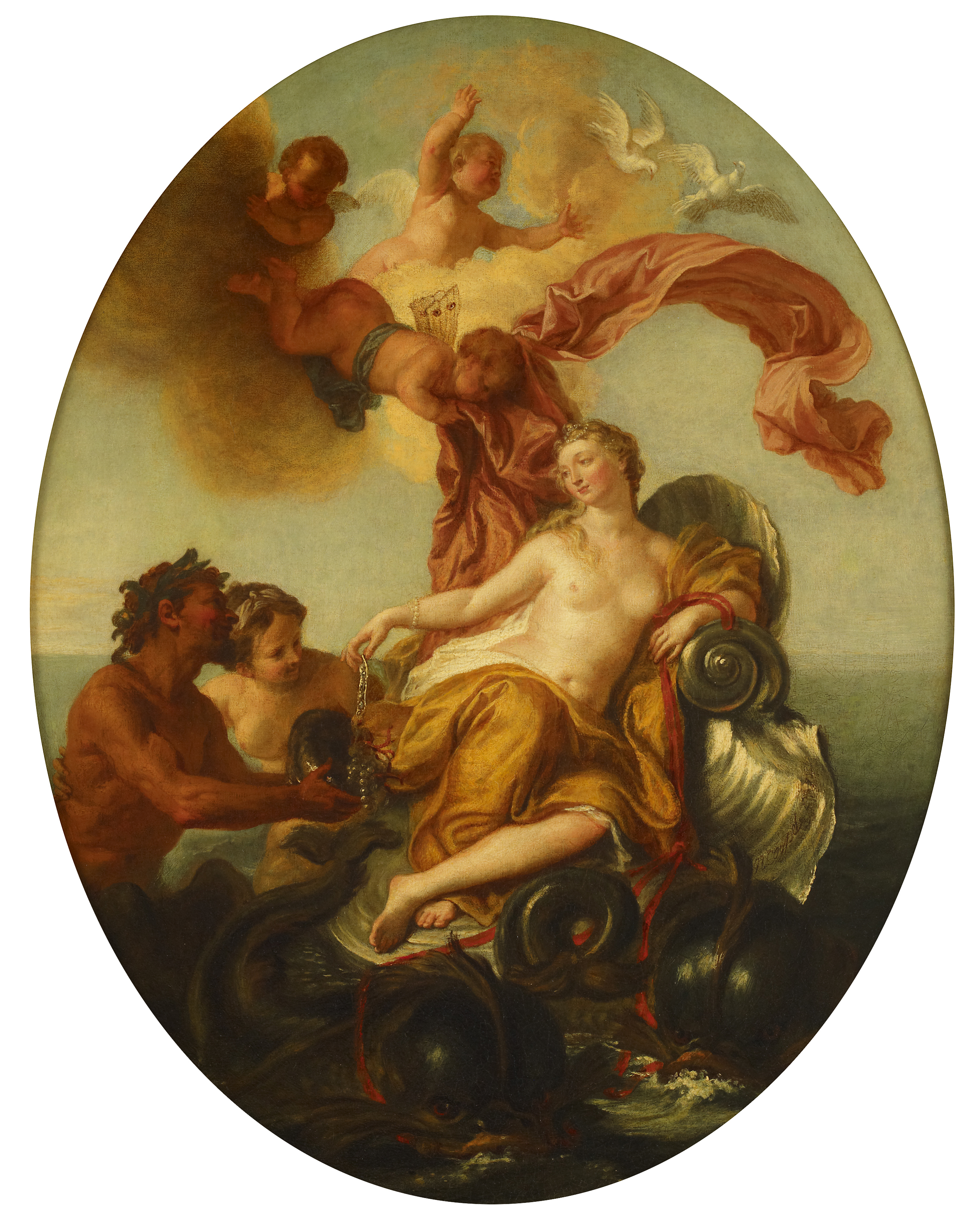
Description:
Follower of NOËL NICOLAS COYPEL (French 1690-1734) "The Birth of Venus" A Very Fine Oil on Canvas, painted in the oval shape, depicting the mythological theme of a restinge semi-nude Venus on a cockleshell throne below hovering cherubs, one releasing freedom doves, while the sea god Neptune offering her pearl jewels, within an an ornate gildwwod carved frame, the bottom inscribed: Noël Coypel (1625-1707). Bearing the signature: N. Coypel
Height: 32 3/8 inches (82.2 cm)
Width: 25 5/8 inches (65.1 cm)
Provenance:
Sotheby Parke Bernet, New York, sale of June 18, 1974, lot 31 as 'Noel Coypel'.
Private Collection, The Bronx, New York.
Exhibited:
Loch Haven Art Center, Orlando, Florida, April 1973.
Museum of Fine Arts, St. Petersburg, Florida, June 1973
Ref.: A1839
Click here to go back the original page for this painting
The Birth of Venus:
Venus is the Roman goddess whose functions encompassed love, beauty, sex, fertility, prosperity and victory. In Roman mythology, she was the mother of the Roman people through her son, Aeneas, who survived the fall of Troy and fled to Italy. Julius Caesar claimed her as his ancestor. Venus was central to many religious festivals, and was venerated in Roman religion under numerous cult titles.
The Romans adapted the myths and iconography of her Greek counterpart Aphrodite for Roman art and Latin literature. In the later classical tradition of the West, Venus becomes one of the most widely referenced deities of Greco-Roman mythology as the embodiment of love and sexuality.
Venus embodies sex, beauty, enticement, seduction and persuasive female charm among the community of immortal gods; in Latin orthography, her name is indistinguishable from the Latin noun venus ("sexual love" and "sexual desire"), from which it derives.Venus has been described as perhaps "the most original creation of the Roman pantheon", and "an ill-defined and assimilative" native goddess, combined "with a strange and exotic Aphrodite".
Her cults may represent the religiously legitimate charm and seduction of the divine by mortals, in contrast to the formal, contractual relations between most members of Rome's official pantheon and the state, and the unofficial, illicit manipulation of divine forces through magic. The ambivalence of her function is suggested in the etymological relationship of the root *venes- with Latin venenum (poison, venom), in the sense of "a charm, magic philtre".
In myth, Venus-Aphrodite was born of sea-foam. Roman theology presents Venus as the yielding, watery female principle, essential to the generation and balance of life. Her male counterparts in the Roman pantheon, Vulcan and Mars, are active and fiery. Venus absorbs and tempers the male essence, uniting the opposites of male and female in mutual affection. She is essentially assimilative and benign, and embraces several otherwise quite disparate functions, She can give military victory, sexual success, good fortune and prosperity. In one context, she is a goddess of prostitutes; in another, she turns the hearts of men and women from sexual vice to virtue.
Venus' signs were for the most part the same as Aphrodite's. They included roses, which were offered in Venus' Porta Collina rites, and above all, myrtle (Latin murtos), which was cultivated for its white, sweetly scented flowers, aromatic, evergreen leaves and its various medical-magical properties. Before its adoption into Venus' cults, myrtle was used in the purification rites of Cloacina, the Etruscan-Roman goddess of Rome's main sewer; later, Cloacina's association with Venus' sacred plant made her Venus Cloacina. Likewise, Roman folk-etymology transformed the ancient, obscure goddess Murcia into "Venus of the Myrtles, whom we now call Murcia". Venus' statues and her worshipers wore myrtle crowns at her festivals.
Roman generals given an ovation, a lesser form of Roman triumph, wore a myrtle crown to purify themselves and their armies of blood-guilt. The ovation was assimilated to Venus Victrix ("Victorious Venus"), who was held to have granted and purified its relatively "easy" victory.
Myrtle was thought a particularly potent aphrodisiac. The female pudendum, particularly the clitoris, was known as murtos (myrtle). As goddess of love and sex, Venus played an essential role at Roman prenuptial rites and wedding nights, so myrtle and roses were used in bridal bouquets; but the marriage itself was under the authority of Juno, not Venus; so myrtle was excluded from the bridal crown. In the rites to Bona Dea, a goddess of female chastity, Venus, myrtle and anything male were not only excluded, but unmentionable. The wine used at these rites was not Venus' ordinary, everyday wine but Jupiter's wine, the strongest, sacrificial grade, which was otherwise reserved for the Roman gods, and for Roman men. For the duration of the festival it was euphemistically referred to as "honey". Under these special circumstances, the women could get virtuously, religiously drunk on strong wine, safe from Venus' temptations. Outside of this context, ordinary wine (that is, Venus' wine) tinctured with myrtle oil was thought a particularly suitable drink for women.
Venus became a popular subject of painting and sculpture during the Renaissance period in Europe. As a "classical" figure for whom nudity was her natural state, it was socially acceptable to depict her unclothed. As the goddess of sexuality, a degree of erotic beauty in her presentation was justified, which appealed to many artists and their patrons. Over time, venus came to refer to any artistic depiction in post-classical art of a nude woman, even when there was no indication that the subject was the goddess.
* The Birth of Venus (Botticelli) (c. 1485)
* Sleeping Venus (c. 1501)
* Venus of Urbino (1538)
* Venus with a Mirror (c. 1555)
* The Rape of Europa COYPEL, Noel-Nicolas (c. 1727)
* Olympia (1863)
* The Birth of Venus (Cabanel) (1863)
* The Birth of Venus (Bouguereau) (1879)
* Venus Victrix, & Venus Italica by Antonio Canova
In the field of prehistoric art, since the discovery in 1908 of the so-called "Venus of Willendorf" small Neolithic sculptures of rounded female forms have been conventionally referred to as Venus figurines. Although the name of the actual deity is not known, the knowing contrast between the obese and fertile cult figures and the classical conception of Venus has raised resistance to the terminology.
In Wagner's opera Tannhäuser, which draws on the medieval German legend of the knight and poet Tannhäuser, Venus lives beneath the Venusberg mountain. Tannhauser breaks his knightly vows by spending a year there with Venus, under her enchantment. When he emerges, he has to seek penance for his sins.
References:
Wikipedia
COPYRIGHT
& DISCLOSURE:
The images, logo, design, text, information and all material
displayed on this site are protected by U.S. and international copyright
laws and may not be printed, saved or reproduced except for personal use
only. Unauthorized use is prohibited. No part of this website may be published,
stored or transmitted in any form or by any means without permission and
authorization in writing from Jan's & Company French Antiques, Attn: Rights
& Reproductions, at 1904 West Adams Boulevard, Los Angeles, CA 90018 U.S.A.
Tel: (323) 735-6455