

Description:
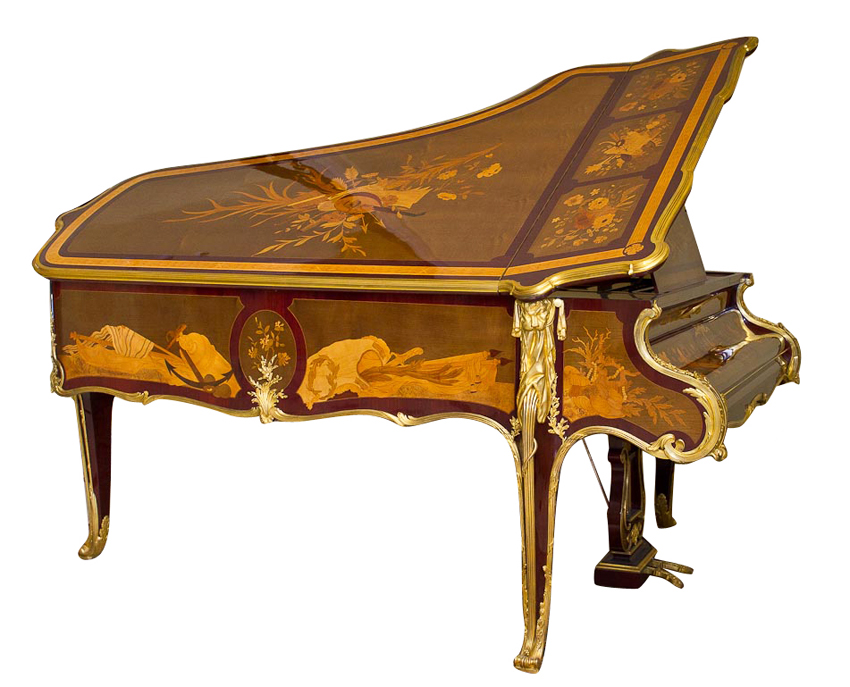
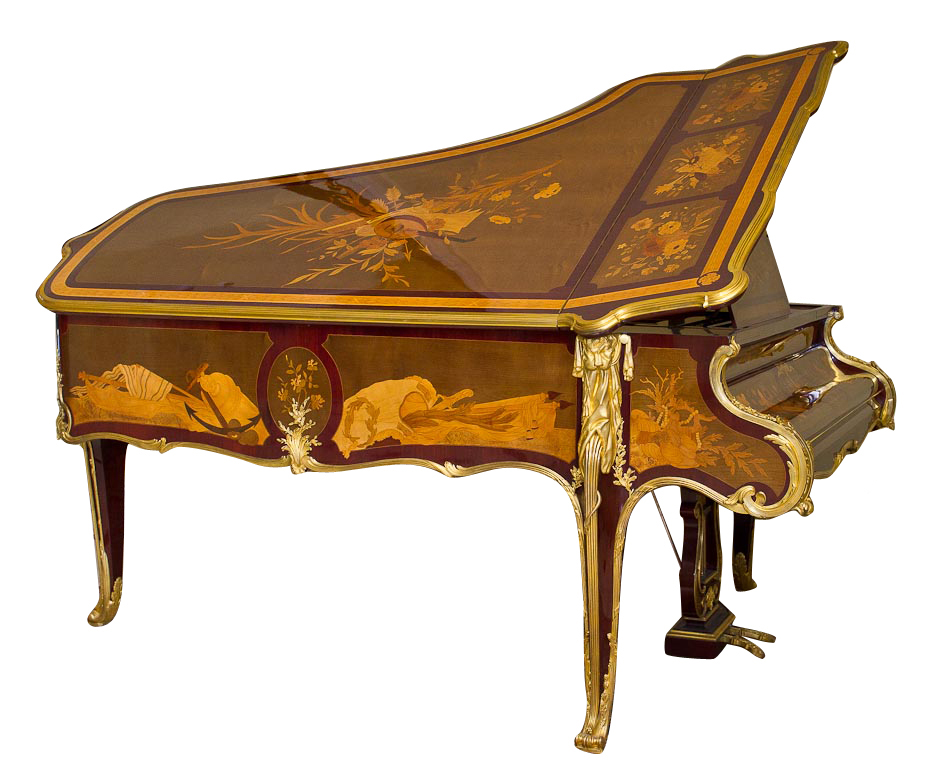
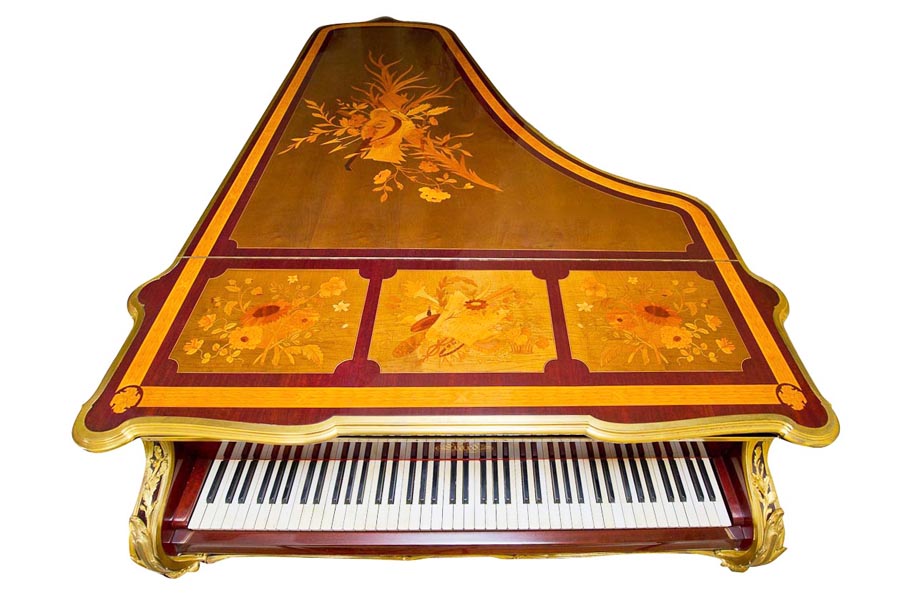
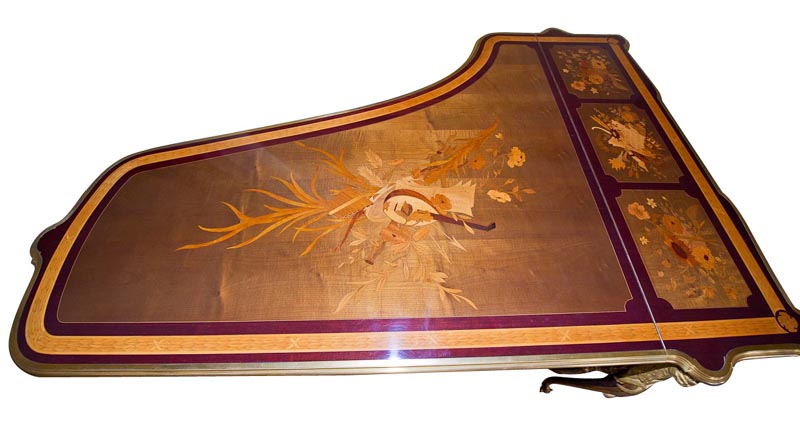
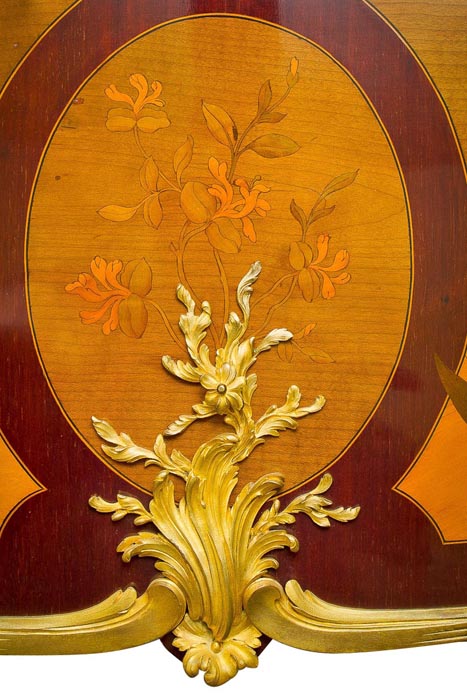
A Very Important and Rare French Early 20th Century Ormolu-Mounted and Marquetry Art-Case Grand Piano à Queue, The Movement by Erard, Paris and the Art-Case by François Linke (1855-1946). The ornate mahogany, Satiné and stained end-cut-marquetry art-case veneered in amaranth, sycamore, bois satiné and exotic fruitwoods with designs of laurel-festooned in celebration of 'abundance through labour' surmounted with lion-pelts, recalling Hercules' labours, flanked on each of the three square-tapering legs by a draped Herculean lion-pelt, the sides similarly-inlaid and with a laurel-cast festoon above and palm fronds below, each with reeded tapering mount and scrolled acanthus foot. The hinged serpentine ormolu-molded top centered by a marquetry trophy of Music and Sciences, a Flauto di Pan and a Mandolin, all flanked with floral arrangements and an entrelac ormolu molded edge, the fold-over section similarly decorated with festive marquetry garlands, music notes, arrows and a Royal crown. The keyboard lid equally designed with festive music and floral marquetry and the inside signed in brass inlaid cursive letters Erard - Paris. The sides with decorated floral arrangements, flags, scrolls, wreaths and an anchor allegorical to the triumph of marine battles. The inspiration for the mounts of this magnificent art-case grand piano are derived from models that were executed by the foundry of Jean-Claude Duplessis (d. 1774) for the celebrated Bureau du Roi by Jean-Henri Riesener (d. 1806) and Jean-François Oeben (matre 1759) which was commissioned by Louis XV and delivered to the King in May, 1769. By the end of the 19th century, after the grand bureau had been moved to the Palais de Saint-Cloud, copies were manufactured by the leading Parisian Ébénistes including Joseph Emmanuel Zwiener (German, b.1849) and Henry Dasson (d. 1896), whose models appear to have been acquired by F. Linke. The front-right ormolu mount signed F. Linke and with FL cast to the underside of all mounts. All gilt bronze mounts with mercurial gilding and two toned burnishing. Serial No. 95417. The sound board inscribed "Par Brevet d'Invention Seb. & Pre Erard 13 & 21 rue du Mail Paris. Circa: 1901-1910".
François Linke (d. 1946) was awarded the gold medal for his Grand Bureau at the 1900 Paris Exposition Universelle. He was the most celebrated Ébéniste of his time. Born in Bohemia in 1855, he moved to Paris in 1881. He produced furniture of the highest quality at his workshops at 170, rue du Faubourg-Saint-Antoine, and established showrooms at 26, Place Vendme. An identical piano by Linke is illustrated in Denise Ledoux-Lebard's "Le Mobilier Français du XIX Sicle - Dictionnaire Des Ébénistes et des Menuisiers", Paris, 1984, page 441. Another identical piano by Linke is also illustrated in Christopher Payne's "François Linke 1855-1946 The Belle Epoque of French Furniture" Antique Collectors' Club, 2003 Edition, Index 773, Page 454. According to Christopher Payne's book (Page 226), there were only two of these pianos made by Linke. One example is recorded in Linke's registre under model number 1773, ordered in 1907 by a Mr. Laporte at a cost price of 6,414 francs with an Erard movement and selling at 15,000 francs. The second piano, according to Payne's book, was part of an extensive order made in 1909 for Mr. Elias Meyer in London.
Length: 91 inches (231.2 cm)
Width: 61 inches (155 cm)
Height: 41 inches (104.2 cm)
Ref.: A1863






 Facebook
 Twitter
 Linked In
 Pinterest