

Description:
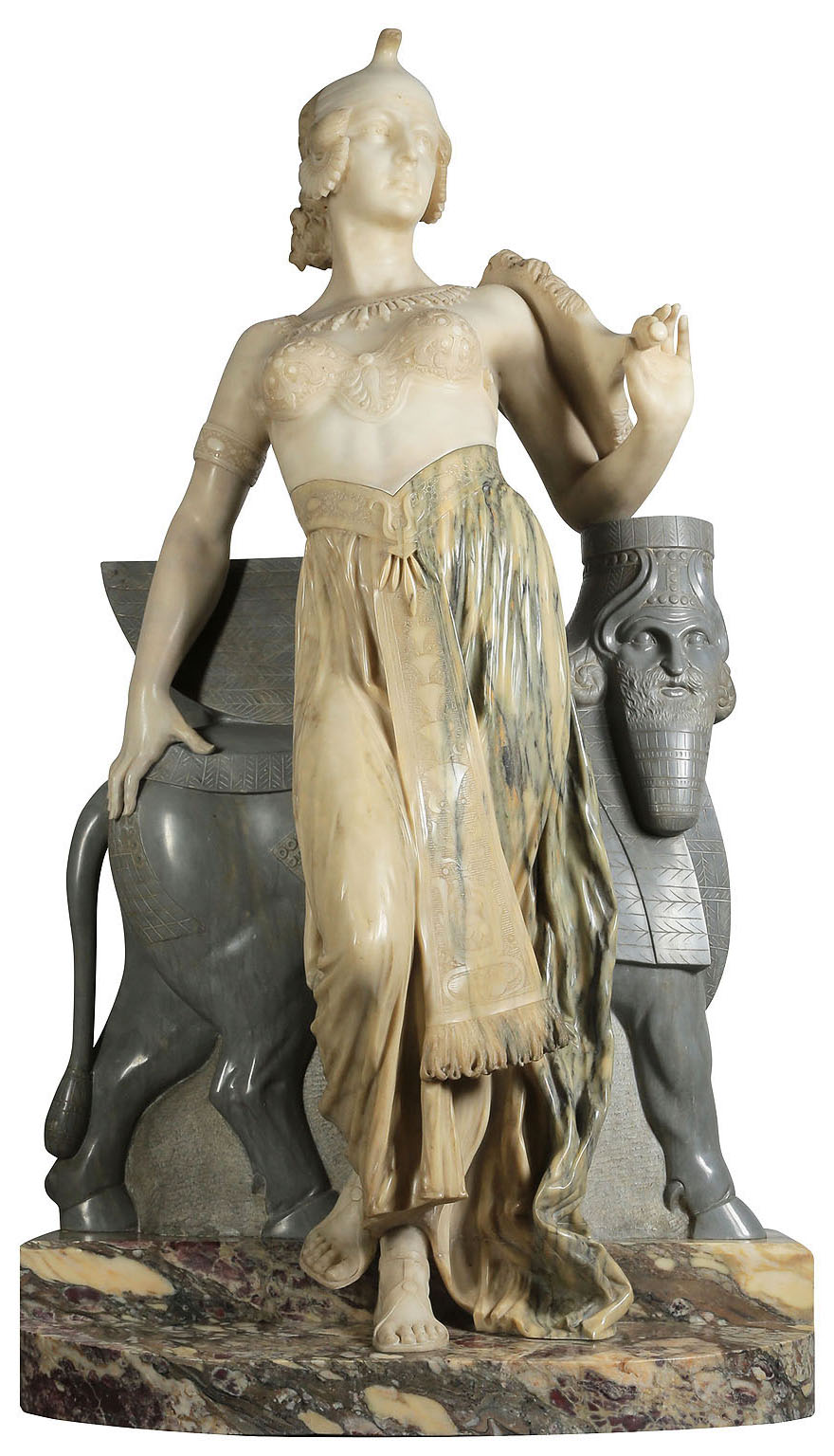
Eliseo Tuderte Fattorini (Italian, 1830-1887). A very fine and life-size Italian, 19th century marble Life-size Orientalist Marble Sculpture of an Assyrian Princess (Previously described as Cleopatra). The impressive 'quattro colori' (Four-Color) marble sculpture in white statuary Carrara, Brêche Verte, Violette de Seravezza and Grey Bardiglio Imperiale, a perfect example of The Aesthetic Movement Period (1860-1900) shows an alluringly standing and slender maiden leaning against an Assyrian winged bull (Assyrian Lamassu Guardian), her left hand holding an ostrich plume fan, her short ringlets held under a royal bird headdress, wearing palmette earrings, a necklace hanging across her breast, wearing a bejeweled bodice, her long skirt held by a jeweled belt with long fringed sash decorated with papyrus umbels, wearing leather sandals. Signed: E. Fattorini, Firenze. Circa: Florence, 1870-1880.
Provenance: A Private Mid-West Collection.
Sculpture Height: 5 feet 9 inches (175 cm)
Sculpture Width: 38 1/2 inches (97.8 cm)
Sculpture Depth: 26 1/4 inches (66.7 cm)
Pedestal Height: 28 inches (71,1 cm)
Pedestal Width: 47 3/4 inches (121.3 cm)
Pedestal Depth: 30 inches (76.2 cm)
Overall Height: 97 inches (246.4 cm)
Ref.: A1768 - THIS ITEM IS NO LONGER AVAILABLE
This sculpture is illustrated in Maurice Rheims, 19th Century Sculpture, Thames and London Ltd., London, 1977, page 407. Another later example of this work, but entirely in white statuary Carrara marble and by Henri Emile Allouard (French, 1849-1929) was offered at Christie's London, 19th Century Sale Number 5017, Lot 264 on 15 July 1993 and was then re-offered at Christie's New York, Park Avenue, Property from the Collection of Lord and Lady White of Hull, Sale Number 8656, Lot 73, on 30 April 1997.
It is interesting to note that on the later sale at Christie's New York, the cataloguer makes reference to the present work and assumes that Fattorini was a student at Allourd's Atelier writing: "Due to the popularity of the present work we can assume that Fattorini was a student in Allouard's atelier, commissioned to make a studio copy of this popular piece. Allouard was a frequent exhibitor at the Paris Salon from 1865 to 1928. He studied under Lequesne and Schanewerck and works by him are known in a variety of materials such as terracota, bronze, ivory, precious metals and marble. He exhibited at the Exposition Universelle in 1889 and was awarded a gold medal there in 1900." - However, Allouard's work is a much simpler version of this work and entirely carved in plain white statuary Carrara marble, while Fattorini's work is more complex, carved in four different marbles. This fact and also the fact that Fattorini died in 1887 at age 57, when Allouard was just 38 years old, one must reject the notion that Fattorini was Allouard's student, but that it was actually the other way around.


Literature:
Maurice Rheims, La Sculpture au XIXe, Paris, 1972, p. 407, no. 10 - illustrated p. 412, no. 10
Maurice Rheims, 19th Century Sculpture, Thames and London Ltd., London, 1977, p 407
J. Mackay, The Dictionary of Western Art in Bronze, Woodbridge, 1977, p. 24
Pierre Kjellberg, Les Bronzes du XIXe Siècle, Paris, 1987, p. 39
Semiramis - The Assyrian Queen of Babylon:
The real and historical Shammuramat (in Greek, Semiramis), was the Assyrian queen of Shamshi-Adad V (ruled 824 BC–811 BC), King of Assyria and ruler of the Neo Assyrian Empire, and its regent for four years until her son Adad-nirari III came of age. The Greeks gave her the name Semiramis and it is believed that she may have founded the famous Hanging Gardens of Babylon, one of the seven wonders of the ancient world.
The legends narrated by Diodorus Siculus, Justin and others from Ctesias of Cnidus make a picture of her and her relationship to King Ninus, himself a mythical king of Assyria, not attested in the Assyrian King List.
The name of Semiramis came to be applied to various monuments in Western Asia, the origin of which was forgotten or unknown. Ultimately every stupendous work of antiquity by the Euphrates or in Iran seems to have been ascribed to her, even the Behistun Inscription of Darius. Herodotus ascribes to her the artificial banks that confined the Euphrates and knows her name as borne by a gate of Babylon. The Hanging Gardens of Babylon, one of the Seven Wonders of the Ancient World are also known as the Hanging Gardens of Semiramis.
Various places in Assyria, Mesopotamia, Medea, Persia and Asia Minor bore the name of Semiramis, but slightly changed, even in the Middle Ages, and an old name of the city of Van was Shamiramagerd. Assyrians still name female children Semiramis to this day.
According to the legend as related by Diodorus, Semiramis was of noble parents, the daughter of the fish-goddess Derketo of Ascalon in Syria and a mortal. Derketo abandoned her at birth and drowned herself. The child was fed by doves until she was found and brought up by Simmas, the royal shepherd. Afterwards she married Onnes or Menones, one of the generals of Ninus. Ninus was so struck by her bravery at the capture of Bactra that he married her.
She and Ninus had a son named Ninyas. After King Ninus conquered Asia, including the Bactrians, he was fatally wounded by an arrow. Semiramis then masqueraded as her son and tricked her late husband's army into following her instructions because they thought these came from their new ruler. After Ninus's death she reigned as queen regnant, conquering much of Asia.
Not only was she able to reign effectively, she also added Ethiopia to the empire. She restored ancient Babylon and protected it with a high brick wall that completely surrounded the city. She is also credited with inventing the chastity belt. Roman historian Ammianus Marcellinus credits her as the first person to castrate a male youth into eunuch-hood: "Semiramis, that ancient queen who was the first person to castrate male youths of tender age" (Lib. XIV).
Assyria (Assyriah -  ):
):
Assyria is the beginning of the second stage of the kingdom of Nimrod:
"The beginning of his kingdom was Babel and Erech and Accad and Calneh, in the land of Shinar. From that land he went forth into Assyria, and built Nineveh and Rehoboth-Ir and Calah, and Resen between Nineveh and Calah; that is the great city." - Genesis 10:10-12
Assyria was a Semitic Akkadian Kingdom, extant as a nation state from the mid–23rd century BC to 608 BC centred on the Upper Tigris river, in northern Mesopotamia (present day northern Iraq), that came to rule regional empires a number of times through history. It was named for its original capital, the ancient city of Assur (Hebrew: . Assyria was also sometimes known as Subartu, and after its fall, from 605 BC through to the late 7th century AD variously as; Athura, Syria (Greek), Assyria (Latin) and Assuristan. The term Assyria can also refer to the geographic region or heartland where Assyria, its empires and the Assyrian people were centred. Their descendants still live in the region today, and they form the Christian minority in modern Iraq, and exist also in north east Syria, south east Turkey and north west Iran.
Assyria evolved in the 23rd century BC as a minor Akkadian Kingdom. At the beginning, the early Assyrian kings would certainly have been regional leaders only, and subject to Sargon of Akkad who united all the Akkadian speaking peoples of Mesopotamia under the Akkadian Empire which lasted from 2334 BC to 2154 BC. After the fall of the Akkadian Empire circa 2154 BC, it eventually coalesced into two separate nations; Assyria in the north, and some time later Babylonia in the south.
In the Old Assyrian period of the Early Bronze Age, Assyria had been a kingdom of northern Mesopotamia (modern-day northern Iraq), at first competing with the Sumero-Akkadian states of southern Mesopotamia for dominance of the region, and from the late 19th century BC with the newly created state of Babylonia. During this period it established colonies in Asia Minor, and under Ilushuma it asserted itself over southern Mesopotamia also.. It had experienced fluctuating fortunes in the Middle Assyrian period. Assyria had a period of empire under Shamshi-Adad I in the 19th and 18th centuries BC, following this it found itself under short periods of Babylonian and Mitanni-Hurrian domination in the 18th and 15th centuries BC respectively, and another period of great power and empire from 1365 BC to 1076 BC, that included the reigns of great kings such as Ashur-uballit I, Tukulti-Ninurta I and Tiglath-Pileser I. Beginning with the campaigns of Adad-nirari II from 911 BC, it again became a great power, overthrowing the Twenty-fifth dynasty of Egypt and conquering Egypt, Babylonia, Elam, Urartu/Armenia, Media, Persia, Mannea, Gutium, Phoenicia/Canaan, Aramea (Syria), Arabia, Israel, Judah, Edom, Moab, Samarra, Cilicia, Cyprus, Chaldea, Nabatea, Commagene, Dilmun and the Hurrians, Sutu and Neo-Hittites, driving the Ethiopians and Nubians from Egypt, defeating the Cimmerians and Scythians and exacting tribute from Phrygia, Magan and Punt among others. After its fall, from 612 BC through to 605 BC, Assyria remained a province under the Babylonian, Achaemenid, Seleucid, Parthian, Roman and Sassanid empires until the Arab Islamic invasion and conquest of the mid 7th century AD, when it was dissolved as an entity.
Assyrian Winged Bull Statues (Assyrian Lamassu Guardian):
The Assyrian Winged Lion and Bull Statues known as the Lamassu's sculptures were placed throughout the cities, temples and palaces of Assyria as guardians. One particular set stood at the gateway to the palace of Assurnasirpl II. Referred to as the Human-Headed Winged Bull and Lion, its size is impressive from over 10 feet high and 10 feet long. These magnificent creatures were discovered by archaeologist Austen Henry Layard in 1899. They feature complementary views of majestic hybrid animals associated with Assyrian leadership. The sculptures combine elements of the noblest animals beginning with the head of a man, the body of a lion or bull (ancient symbol of fertility) and an eagle's wings. A set of fourteen foot sculptures from Neo-Assyrian Period, reign of Sargon II (721-705 BC) that flanked the gateway to the noble King Assurnasirpl II palace are currently part of the collection at the Louvre Museum in Paris.
During the dawn of civilizations, a group that ruled with military power and administrative efficiency also produced impressive pieces of art. Assyria ruled Mesopotamia from about 1000 - 612 BCE. The Assyrian civilization used military organization, strength and fear to conquer the northern part of the Fertile Crescent and control the area for about 400 years. Besides being known for their power and cruelty they were also believed to be master artisans. The city of Nineth housed a library with over 20,000 clay tablets depicting every facet of daily life. The city of Kalhu, present day Nimrud, housed the palace of Assurnasirpl II and many beautiful sculptures and carvings. As noble and refined as the Assyrians may have been, they wanted the rest of the world to know the power and dominance of their kings; the Lamassu conveyed just that.
The figure is a winged bull with a human head, the body of the bull has five legs. This is to aid in the visual effects from a frontal and side view. The frontal view shows two massive rooted legs supporting the muscular torso, shoulders and head. The side view uses the extra leg to show a striding stance. The side also displays three layers of overlapping feathers that create sturdy yet intricate wings. The head supports a full, curled beard ascending from a formidable yet handsome face. The wavy hair rests on the shoulders while being topped with a smooth domed crown sprouting three sets of bull horns wrapping around the front. Archeologist Austen Henry Layard believes this expressive face to be the reflection of Assurnasirpl II.
Italian Singer Orietta Berti Visit to Jan's & Co. Fine French Antiques, Inc. - February 2012


 Facebook
 Twitter
 Linked In
 Pinterest