

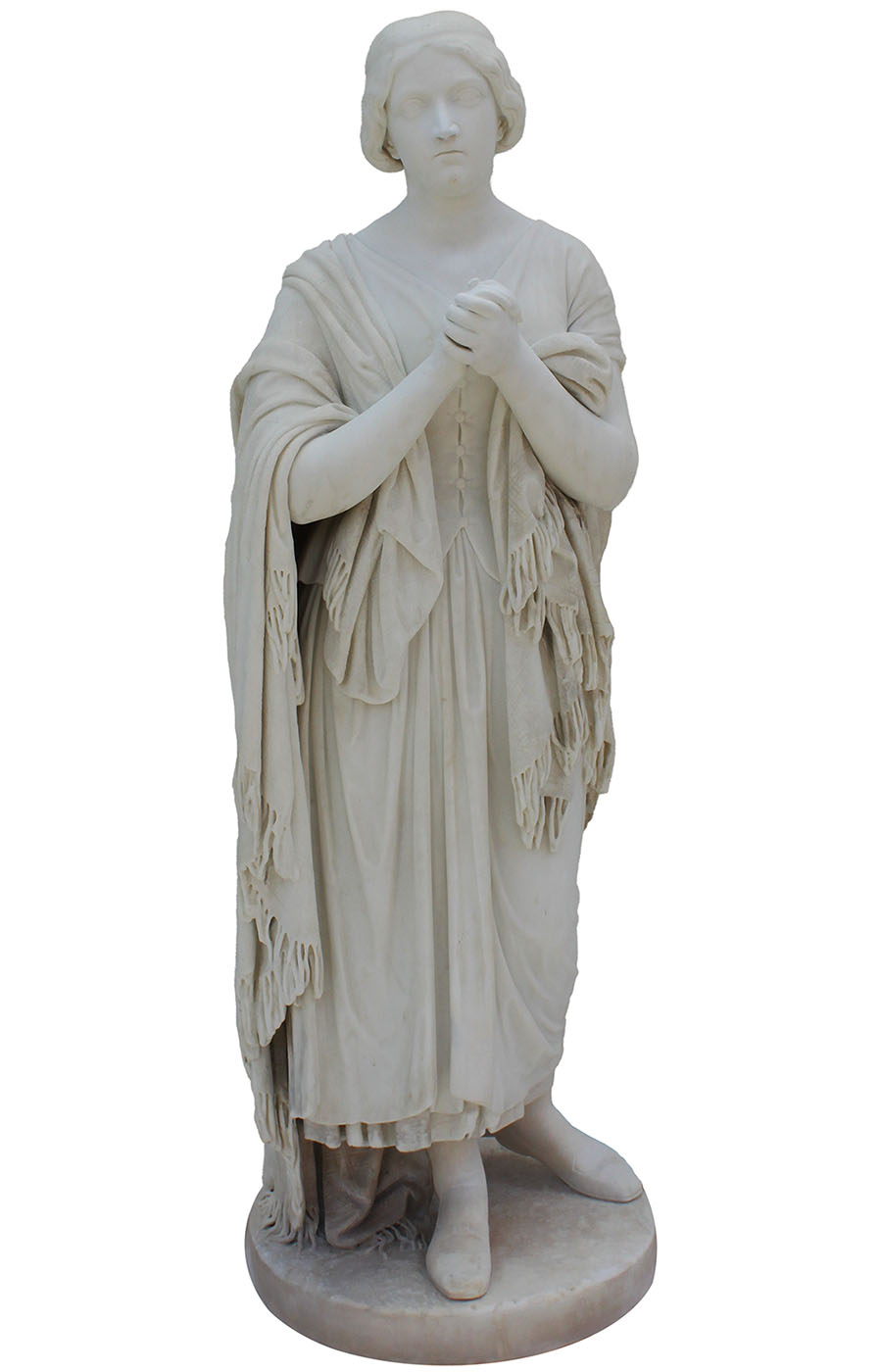
Description:
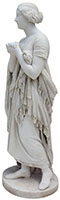
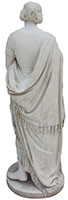
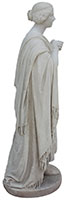
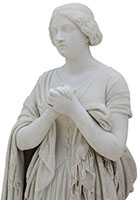
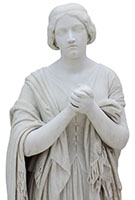
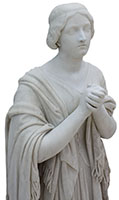
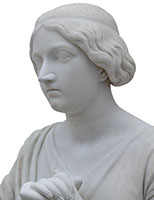
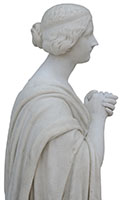
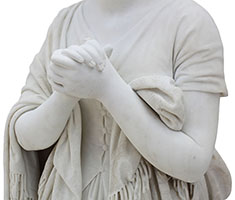
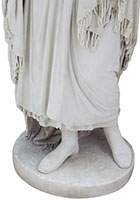
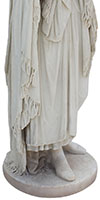
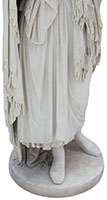
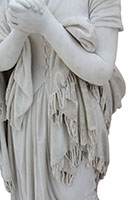
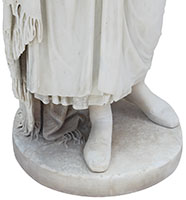
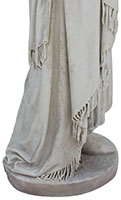
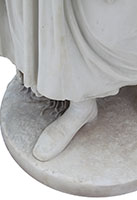
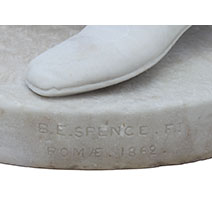
"Highland Mary" (also known as Highland Mary or a portrait of Mary Campbell) Carved White Marble Sculpture by Benjamin Edward Spence (British, 1822–1866). A fine full-length, life-size neoclassical carved statue depicts the subject of Robert Burns’s poem Highland Mary (Mary Campbell), shown as a young woman standing in a contemplative pose. The sensual carved figure with a gentle contrapposto stance, weight resting on her left leg, right foot slightly advanced, and her head tilted downward with a solemn, introspective gaze. Her hair is centrally parted and styled in soft classical waves framing the face. She wears a long, fitted floor-length gown with a buttoned bodice and full skirt falling in graceful folds, over which is draped an asymmetrically arranged, heavily fringed plaid shawl (tartan implied through carved texture). Both hands are clasped together at her chest in a reflective gesture, fingers gently interlaced. She wears simple low-heeled slippers. The sculpture stands on a plain circular marble plinth. The work exhibits the refined carving and smooth finish characteristic of Spence’s mid-19th-century neoclassical style, with particular attention to the soft drapery, fringe details, and textural contrast between fabric and skin. Multiple versions of Highland Mary are known (including examples in the Royal Collection, Walker Art Gallery, Liverpool, and Sefton Park Palm House), with minor variations in pose and attributes; the present example corresponds to the clasped-hands composition. Signed: B.E. SPENCE Ft. ROMAE - 1862
Provenance / Literature note: Frequently exhibited and replicated during the Victorian period as one of Spence’s most celebrated works, inspired by the tragic romance between Mary Campbell and the poet Robert Burns.
Height: 63 inches (160 cm)
Width: 21 inches (53.4 cm)
Depth: 21 inches (53.4 cm)
Ref.: A2885 - Lot 10078
Benjamin Edward Spence (1822–1866) was a 19th century English sculptor, who spent much of his professional life in Italy. He was born in Liverpool in December 1822, the son of William Spence, a sculptor who later in life became a partner in a business house in Liverpool, and gave up the profession. In 1846 he was awarded the Heywood silver medal and a cash prize by the Royal Manchester Institution for a group in clay of the death of the Duke of York at the battle of Agincourt. His father was persuaded by John Gibson to send Edward to Rome. There he entered the studio of Richard James Wyatt, and also received help from Gibson. He died at Livorno (then known as Leghorn) on 21 October 1866.
Between 1849 and 1867 Spence contributed to the exhibition of the Royal Academy five times: in 1850 with "Ophelia", in 1856 "Venus and Cupid", in 1861 "Hippolytus", and in 1867 "The Parting of Hector and Andromache". He contributed "Highland Mary" to the Exposition Universelle 1855, and two works, "Finding of Moses" and "Jeanie Deans before Queen Caroline", to the International Exhibition 1862. A number works of his that were not exhibited in England were engraved for the Art Journal.
Works:
• Highland Mary 1853, Buckingham Palace
• Venus and Cupid, Philadelphia Museum of Art
• Statue of Lavinia for Mr Holmes of Liverpool (1849)
• Statue of Ophelia for Thomas Brassey MP (1850)
• Tomb of Richard James Wyatt in the Protestant Cemetery, Rome (1851)
• Highland Mary at Osborne House (1854)
• Bas relief in a monument to Ann Catherine Jane Smith (died 1854) in St Matthias' Church, Burley.
• Monument to Lt James Marshall in Leeds Parish Church (1855)
• Busts of Mr and Mrs Thomas Brassey, formerly at Normanhurst Court (dnk)
• Archdeacon Jonathan Brooks at St George's Hall, Liverpool (1856)
• Rebecca at the Well at Walker Art Gallery, Liverpool (1860)
• The Finding of Moses at the International Exhibition 1862
• Jeannie Deans before Queen Caroline at the International Exhibition 1862
• The Angel's Whisper for James Smith of Liverpool (1863)
• The Lady of the Lake for Balmoral Castle (1863)
• Virgin and Child, signed Rome 1865 (Archbishop's House, Roman Catholic Cathedral of Westminster)
• Virgin and Child, marble, 1865,
• Flora MacDonald at Stanley Park, Liverpool (dnk)
References:
• Sidney Lee, ed. (1898). "Spence, Benjamin Edward" . Dictionary of National Biography. Vol. 53. London: Smith, Elder & Co.
• The Art Journal (magazine) 1870 p.221
• A Sculpted White Marble of Figure of The Venus Marina by Benjamin Spence, dated 1866 was sold at Christie's London, Sale 4941, on 7 January 2006, Lot 253, for £33,600 ($59,532)
• A white marble sculpture of "Highland Mary" by Benjamin Edward Spence (British, 1822-1866) dated 1859 was sold at Bonhams New York, Fine American and European Furniture, Silver, Folk and Decorative Arts & Clocks, on 23 January 2014, Lot 1165, for $37,500
• Carved Marble Sculpture of Highland Mary, 1859 was sold at Sotheby's 19th-20th Century Sculpture, Sale 23 May 1994, Lot 66


 Facebook
 Twitter
 Linked In
 Pinterest